
Nov 2025: Inside the Human Loop: How Irish Consumers are Adopting and Assessing AI
November 2025

This report is part of a joint research initiative between Amárach Research and Karen Howley, examining how Ireland’s consumers and workforce are adapting to the realities of artificial intelligence.
This research focuses on consumer adoption and looks at how Irish adults are engaging with AI tools in their everyday lives, from seeking information to discovering and evaluating products.
It shows that AI is becoming a routine part of the digital experience, yet trust and comfort depend on maintaining human oversight. Irish consumers are curious and open to AI-assisted convenience, but they continue to value transparency, consent, and control.
AI adoption is broadening and becoming habitual
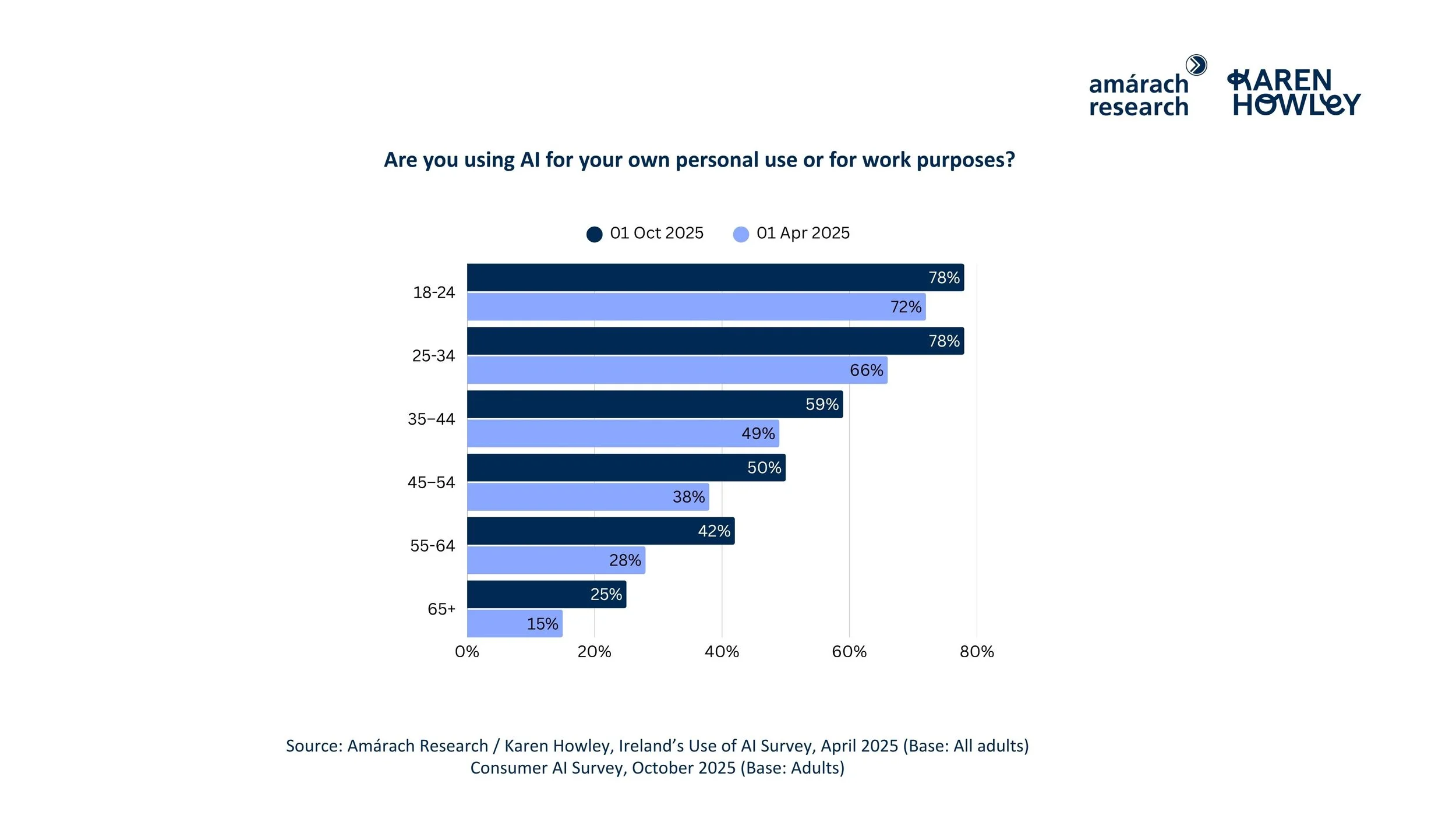
More than half of Irish adults (53%) now use AI tools such as ChatGPT, Gemini, or Copilot - a ten-point increase since April 2025. Adoption is no longer confined to younger demographics. Those aged 35 and over saw the biggest rise, with an average increase of 11 points.
Under-35s remain the most active group with 78% using AI, but growth across older cohorts shows that AI is moving from early adoption to mainstream behaviour.
AI is becoming part of how people stay informed
Seven in ten Irish adults who use AI (69%) report turning to AI platforms weekly or more often to stay up to date on topics or news . This is evidence of a shift from keyword search to conversational, answer-based discovery.
.

This is not surprising, when we consider that it has been reported that more than 50% of Google queries are now shown as AI Overviews and Google's conversational AI Mode became available for Irish users in October 2025.
As major platforms (e.g., Google, Meta) standardise AI-assisted answers in their default modes of search, brand discovery now flows through generative answers as much as traditional results.
Marketing teams should treat Generative Engine Optimisation (GEO) as a core discipline that helps their brands appear accurately and favourably in LLM‑generated answers across assistants and AI‑enhanced search.
AI is entering the purchase journey, but consumers still control the purse strings
AI’s role in the purchase journey
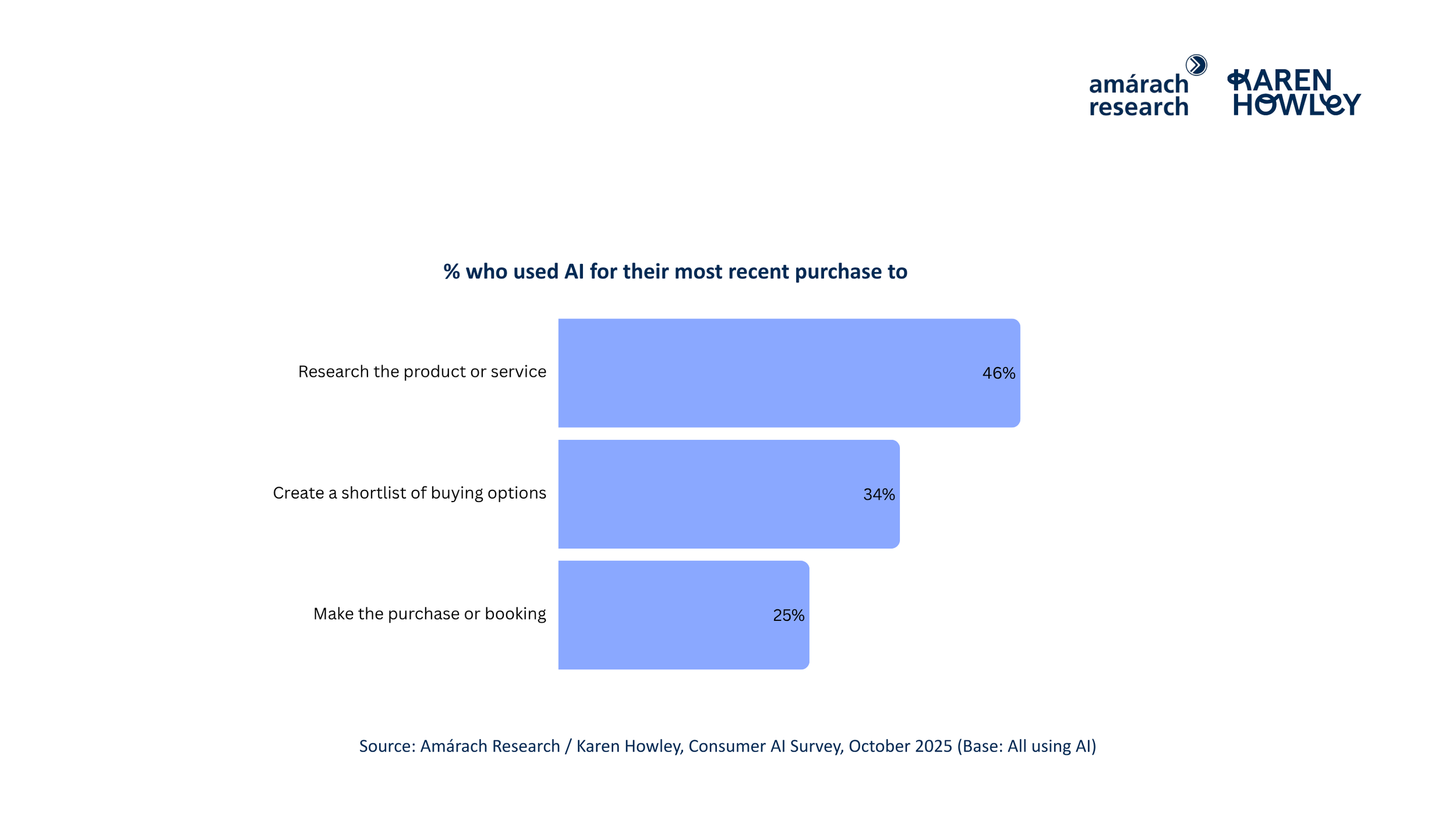
AI is reshaping how consumers find and evaluate products, primarily by disrupting the role of search in brand discovery. Nearly half of AI users (46%) say they have used it to research a recent product or service, and over a third (34%) to create a shortlist. Interestingly, 25% say that AI was involved to make the purchase or booking, suggesting that the role of AI in the purchase journey is extending beyond helping consumers make choices.
How the consumer decision journey is evolving
AI is collapsing the traditional funnel into a single conversational flow. Discovery, evaluation and decision can now happen in one session, as assistants synthesise reviews, weigh trade-offs and generate shortlists in seconds.
New integrations that have launched in the US and other markets, such as Shopify and PayPal within ChatGPT, hint at a next phase of commerce where research and purchase merge seamlessly.
A fragmented e-commerce landscape
The commerce ecosystem remains fractured. Each platform is building its own environment with distinct data, payment and integration rules. The major platforms themselves are actively blocking each other.
For example, Amazon has restricted integrations with multiple AI platforms and has even issued legal threats to Perplexity over agentic browsing. This fragmentation limits consumers’ ability to transact smoothly across assistants and marketplaces.
It also forces brands to decide whether to maintain visibility across every emerging AI environment or focus on those most aligned with their audiences, echoing the strategic choices of social media channel strategies.
People still want a human in the loop
Even as AI assists with more decisions, human oversight remains non-negotiable.
Eight in ten adults want a person involved when receiving medical or legal advice.
More than three-quarters (77%) say the same when sharing financial or personal details.
Seventy-three per cent want human oversight when spending more than €100, and 70% when engaging with an unfamiliar brand.
These views are consistent across age, gender and region. Irish consumers are comfortable with AI-assisted decisions but not AI-only ones.
Quality and oversight now define brand trust
Low-quality AI content is being noticed and judged
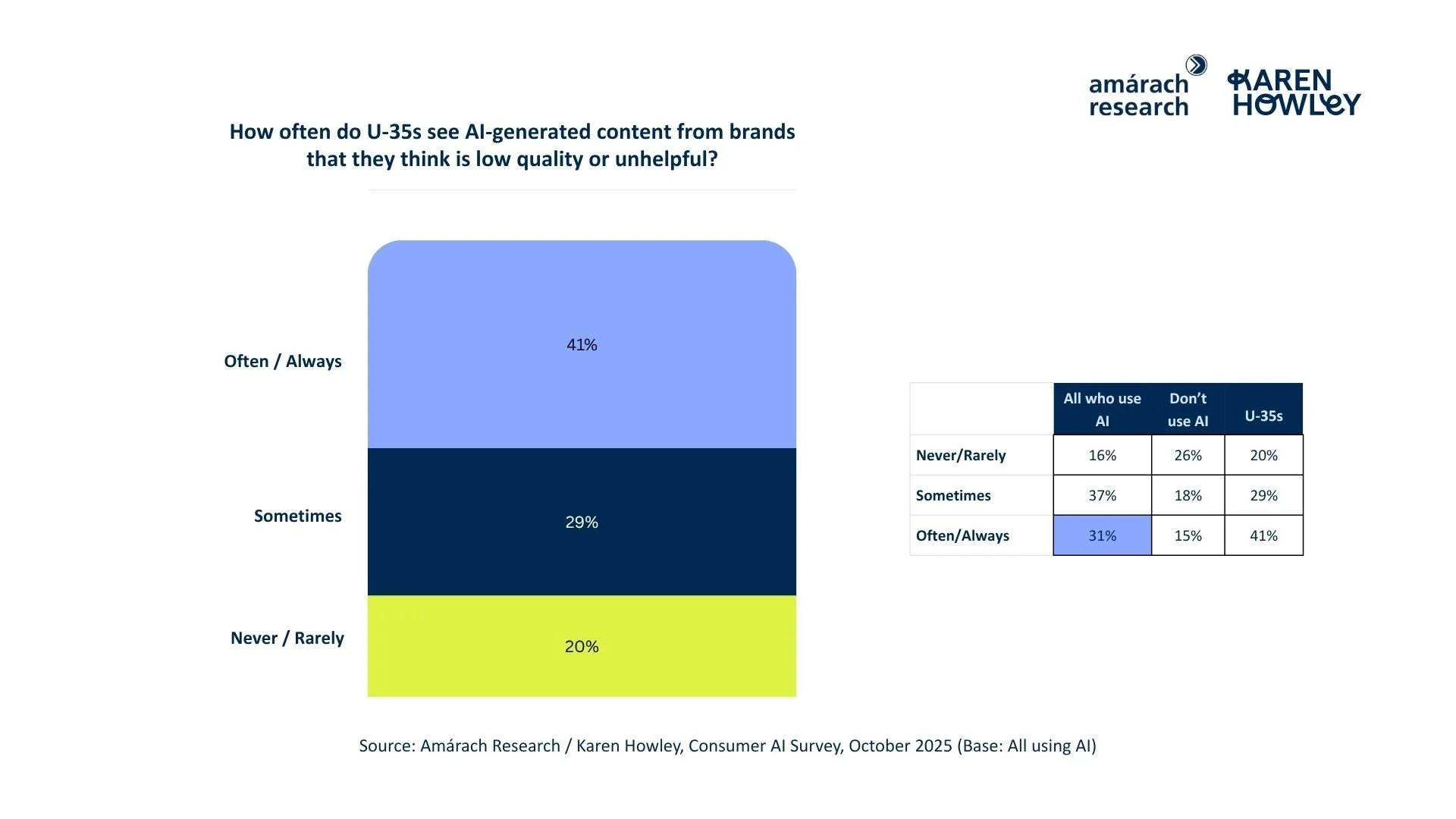
One in three AI users say they often encounter low-quality or unhelpful AI-generated brand content, rising to 41% among under-35s. As people become more familiar with using AI themselves, they are becoming quicker to recognise what looks synthetic and less forgiving when it feels careless.
The issue isn’t AI itself; it’s oversight and varying levels of AI literacy.
Ensuring that human judgement remains central to creative and content workflows is now essential for maintaining quality and consistency.
Two-thirds say poor AI content reduces trust
Two-thirds of consumers say that low-quality or unhelpful AI-generated content would reduce their trust in a brand, a level comparable to the impact of poor customer service or a data breach.
This sentiment underscores a wider point: audiences are judging AI content by the same standards as any other brand interaction.

When the EU AI Act’s transparency rules take effect in 2026, requiring brands to disclose when synthetic people or imagery are used, this sensitivity could increase and on the flip side it could also reduce as AI content gets normalized as part of the way we communicate.
Next steps for brands
1. Monitor visibility in AI environments
As generative search becomes embedded in daily discovery, brands need to know how they appear in AI-generated answers.
Optimising for Generative Engine Optimisation (GEO) and Answer Engine Optimisation (AEO) —by ensuring product data, claims and sources are structured clearly — will be as important as traditional SEO in the years ahead.
2. Strengthen creative oversight
The creative advantages of AI come with reputational risk if quality control weakens. Establish clear review checkpoints for factual accuracy, tone, and brand alignment. Treat AI-assisted work as a draft that still requires human editing and sign-off.
3. Track consumer sentiment over time
Consumer comfort with AI-generated content is evolving quickly. Regular perception tracking and social listening can help identify early shifts in trust, particularly as transparency requirements approach.
4. Experiment carefully with AI-generated creative
Experimentation is essential, but so is caution. Pilot new creative uses of AI in low-risk channels, test for impact, and build governance around approval and disclosure before scaling.
Methodology
This report is based on findings from a nationally representative online survey of 1,000 adults aged 18 and over living in the Republic of Ireland. Fieldwork was conducted by Amárach Research between 24 and 29 October 2025. Quotas were set and results weighted by age, gender, socio-economic group and region to reflect the national population.
The survey measured consumer familiarity, comfort, and trust in AI across a range of everyday scenarios including shopping, content creation, and decision-making. Of the total sample, just over half reported using AI tools such as ChatGPT, Gemini, or Copilot. Results are subject to a margin of error of ±3.1% at the 95% confidence interval.
When we refer to AI tools or digital assistants in this report, we mean platforms such as ChatGPT, Gemini, Microsoft Copilot, Perplexity, Claude, Meta AI, Grok AI, or similar technologies that can answer questions, generate content, make suggestions, or complete simple tasks, whether at home or at work.